Nov 13 2026
October Market Commentary: The AI jitters are back
In a nutshell:
- Tech stocks sold off as AI worries returned, but many other sectors within the wider market rose.
- The RBNZ surprised markets by holding the Official Cash Rate.
- Australian inflation is rising, and its economy looks less rosy.
- Inflation remains above target in most major economies, with central banks balancing inflation risks against economic growth.
Just when markets seemed to have moved past their worries about tech stocks, AI nerves returned. Alphabet (Google’s owner) had results that fell short of expectations, while Intel (maker of computer processors), beat earnings per share forecasts, but still saw shares tumble. Investors took a harder look at AI-related spending, future profits and high valuations, and money moved out of tech and into other sectors, including finance, healthcare and utilities, as a result.
Otherwise, October was same-same but different. Oil prices are still elevated, inflation is still above most governments’ target ranges, and central banks are still working to get it back in the box.
The surprise at home was the Reserve Bank of New Zealand (RBNZ) keeping the Official Cash Rate on hold at 2.75% in a tight 4-3 vote, when many had expected a rise. The sharp jump in bond yields that headlined our September commentary has also eased, as investors moved towards safer investments and worried about global growth.
Here’s what happened around the world.
United States
Third-quarter company earnings season is more than halfway through, and results have been solid, with 82% of S&P 500 companies beating expectations. US stocks hit record highs at the start of the month, but it didn’t last long.
The positive surprises were smaller than the five-year average, and a few big tech names left investors underwhelmed. The tech-heavy Nasdaq fell 2.9% on the final trading day and finished October down 5.3%, illustrating how quickly sentiment towards technology stocks can shift.
The wider economy looks healthy. US GDP grew at an annualised 3.4% in the September quarter. Inflation is still high, with the September Personal Consumption Expenditures (PCE) deflator (the US’s preferred inflation measure) at 3.6%, and the Federal Reserve leaving the Fed funds rate band unchanged in October at 3.75% to 4.00%. The US 10-year Treasury yield eased back below 5%.
The equal-weighted S&P500 tells the story well. It holds the same 500 companies as the regular US share market index but gives each one the same weight (about 0.2%) rather than weighting by size, so the tech giants have far less influence. It rose 4.9% in October, while the regular S&P500 fell 0.9% (though it is still up 10.8% over the year). That points to a tech-sector problem rather than broad weakness in shares.
United Kingdom
The UK Autumn Budget was seen as suitably cautious with the public finances, and financial markets welcomed it, with government bond yields barely moving. The Bank of England remains focused on inflation, which came in at 3.5% for September, and it has been making hawkish noises, suggesting rate increases are en route. The UK share market index, the FTSE100, benefited from the shift away from tech thanks to its heavy weighting in financials and traditionally defensive sectors such as consumer staples and healthcare.
Across the ditch
Australia’s headline inflation rose to 4.3% in the 12 months to September, up from 4.0% the month before, so a hike is expected. Weaker employment figures also suggest the job market is getting tougher.
With the RBNZ on hold, the gap between NZ and Australian interest rates is widening. After the RBNZ announcement, the NZD/AUD exchange rate slipped below 80 cents and has stayed lacklustre. That’s good news for unhedged Australian shares, which are worth more in NZ dollar terms, but not so good for Gold Coast holidays or businesses importing from Australia. The ASX200 also benefited from the move away from tech, rising 1.4% over the month and 0.3% over the year.
Back here at home
The RBNZ’s decision to hold the cash rate was the big news, surprising many as third-quarter inflation came in at 3.7% - still popping out the top of the Bank’s 1–3% target range. With uncertainty over the general election in play, local markets are mostly in wait-and-see mode. The NZ share market index, the NZX50, fell 0.3% in October and is up 1.8% over the year.
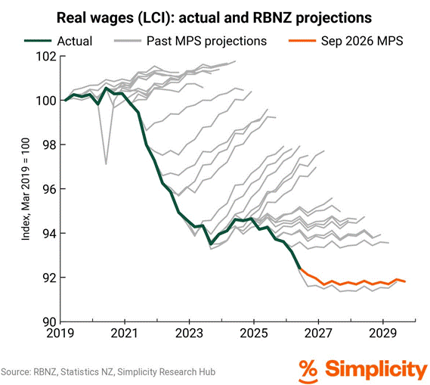
Just in case you’ve been wondering where the purchasing power of your money has been going…
Source: RBNZ, Statistics NZ, Simplicity Research Hub